Wheat's BassBook
Helping Bassists Worldwide Since 1997
Reading Music
Depending upon your musical situation, you could go your entire life never reading
a line of music in standard notation. Musicians communicate in many ways. We
often demonstrate our lines to each other in person or use chord charts as a
short-hand way of representing musical ideas. Many players are quite happy with
tabulature for notating difficult melodies. Recordable media (tape, disk, etc.)
are also efficient way to communicate musical information.
But I'm not trying to talk you out of learning standard notation.
Doing so opens up a world of musical opportunities to any player, and learning to
read isn't as hard as you might think. Not only will you be able to read bass
books and articles not written in tab, but you'll also be albe to read trombone
books (their range closely matches ours), bassoon books (theirs goes only a few
notes lower) and bass lines written as a part of piano music. It doesn't take
the rest of your life to learn how to read music. It just takes regular practice.
And if you try it for at least a month, you'll see continual steady improvement.
It will get easier, I promise. And once you have it under your belt, you'll be
able to play all sorts of (paying) gigs that you might not have otherwise had a
cance to play.
Reading Rhythm Notation, Part I (Counting)
Standard notation, among other things, is a visual means of representing the
pitch and duration of musical notes. Before we learn the pitches of the notes,
let's learn to count some rhythms. This chart summarizes many (but not all) of
the note values you'll encounter most often in written music:
Each of the five lines of this chart shows a different note
which indicates that a note is to be played for a certain amount of time.
You'll notice that, for sake of simplicity, the same note is used for each
exercise. The note is (open) E.
If you have a metronome handy, set it to a relatively
moderate beet (80-100 b.p.m.) and tap your foot along with the click. Your
foot should hit the floor with each click. If you don't have a metronome
(and I strongly suggest that you invest in one) just tap your foot at a steady
tempo. The moment when your foot hits the ground is known as the down beat.
Practice counting aloud (i.e. 1, 2, 3, 4, 1, 2, 3, 4, . . .) with each down-beat
of your foot, and keep your down beats in synch wit the metronome. After you're
comfortable counting, try playing the open A string along with the down beats
(one note per down beat).
Besides the down beat, there is also an up-beat. The up-beat
occures exactly half-way between any two down beats. So the up beats should occur
when your foot is at it's highest point in the air. To count the up beat, we say
"and." On the counting chart, the "ands" are marked with plus signs. Practice
counting along with the metronome as you have already done, but this time add in
the upbeats (i.e. 1 and 2 and 3 and 4 and 1 and 2 and 3 and 4 and . . . ). Be sure
not to slow down your counting. Only the 1, 2, 3, and 4, should occur on the down
beats (i.e. the click of the metronome). The ands should fall in-between.
(When you're first starting out, it's tempting to put every note on the down beat;
resist this temptation). Once you're comfortable counting the down beats and the
up beats, begin playing along on the open A string along with the down beats and
up beats (strike the string once for each down beat and one for each up beat).
Quarter Notes
The third line of the chard shows quarter notes (four of them):
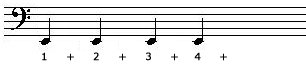
You'll see four black dots with single, vertical lines attached to them.
In musical lingo, the dots are called "heads" and the lines are called "stems."
Beneath each note, you'll see a number, and between
each pair of notes, you'll see an addition sign (+). This bit of standard notation
puts to use what we've learned about counting. Each quarter note starts on a down
beat and lasts until just before the next quarter note begins (exactly where each
note ends depends upon the passage. Standard notation has ways of indicating the
relative length of the notes, but for now we'll stick to the basics). Take a breath,
tap your foot, and count off "1 and 2 and 3 and 4 and" before starting with the
first note of the quarter note line. After you've played the last note (there are
only four of them), stop. Not so hard, eh? It shouldn't be, you've playing
quarter notes (whether you knew it or not) as long as you've been playing bass.
Eighth Notes
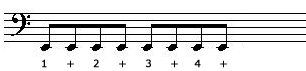
The fourth line of the counting chart illustrates eighth notes:
Notice that eighth notes are also black dots, but each pair of eighth notes
is connected by a single, thick bar (there is also a way of writing single eight
notes, but we'll get to that in a bit). This black bar is what separates eighth
notes visualy from quarter notes. Notice that half of the eighth notes are on the
down beats and half are on the up beats. Keeping your tempo the same as when you
played the quarter notes, count off and play this group of eighth notes.
We can create other values by continuing to sub-divide the
basic (quarter note) beat into shorter notes or by combining beats together into
longer notes. Let's start by combining quarter notes into longer notes.
Half Notes
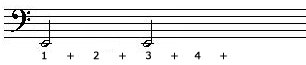
The second line of the counting chart shows two half notes. Notice that half
notes are constructed with a hollow head (it looks like an oval) instead of a
solid dot (like quarter notes). This is the feature, along with the stem,
which distinguishes half notes from all other notes. You'll also notice that
the first half note starts on beat number 1, while the second starts on beat
number 3. When we play a half note, we hold it for two beats. Even though
we will always count using quarter notes (i.e. 1, 2, 3, 4, . . .) or eighth
notes (1, +, 2, +, 3, +, 4, +, . . .), in this example we will only start
a note on the first and third beats. The first half note will end just
before the second half note begins. The second half-note should be just as
long as the first (be careful to hold the note out to its full value. Don't
cut it off just because it's the last thing you have to play. A half note should
always be two beats long, whether it's the first or last note in a piece).
Catch your breath, count off, and play these two notes as you count along with
your metronome.
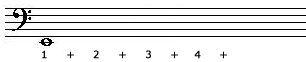
Whole Notes
If you combine two half notes (or four quarter notes) together, you get a whole
note:
Whole notes last the entire length of the measure, no matter how long that
measure may be. In our example, a whole notes last for four beats. One whole
note lasts as long as two half notes, four quarter notes, or eight eighth
notes (hence the names of each). By now you have undoubtedly noticed that each
of our examples is four beats long (even if we play more or fewer than four notes).
Not all music is arranged in groups of four beats (though much of it is, and
that's why we've started here).
Sixteenth Notes
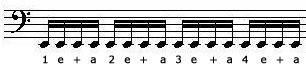
Dividing any eighth notes in half gives you two sixteenth notes:
So we have four sixteenth notes per beat. You can count these several ways, but
I prefer counting them "one-e-and-a, two-e-and-a, three-e-and-a, four-e-and,a"
(the "e" notes are long e's as in "tree"; the "a" notes are short, as in "ah").
The down beats and the upbeats (i.e. the "and" beats) are in the same place
as they would be if we were counting eighths. The "e" and "a" beats fall between
each the up beats and the down beats.
Now let's look at something you've undoubtedly seen before:
the C major scale:
The Major Scale/Ionian mode, Once Again
-----------2-4-5---
-----2-3-5---------
-3-5---------------
-------------------
 C D E F G A B C note names
 R 2 3 4 5 6 7 R scale degrees
A Bunch of Quick Definitions:
Music is writen on a staff, and a staff contains five lines and four spaces. Music
for the bass guitar is written on what is called the "bass clef" and also known as
the "F" cleff (because the two little dots which are part of the bass cleff are on
either side of the line used to designate F. Notes (the little black marks that
indicate you should play something) can be written on any of these lines and spaces.
They can also be written on lines and spaces extending above and below the staff by
the use of added lines called "ledger" lines. As you can see in some of the examples
below, the B is written on the space imediately above the staff and the high C is
written on the first ledger line above the staff.
Below you'll fine the notes of the C major scale as they are
written on the staff. The letter name of each note is written directly beneath
it. Beneath the staff is a diagram of the C major scale showing the note names
in their locations on the fretboard.
Play the above C major scale slowly and concentrate on
each note as you play it. Force your mind to recognize that the second
space of the staff is (and ever shall be) C. Try saying the names of the
notes out loud (or sing them on pitch if you can manage that) as you play them.
Try to remember which note goes with which line or space.
The notes in the next example are also all in C major, but
they go down to the low E (the lowest note on the four string bass in standard
tuning). We'll deal with them more in the reading examples, but try to get a feel
for the locations of as many notes as you can.
Quarter Note Rhythms in 4/4:
Our first reading examples will be comprised entirely of quarter notes. There
will be one on every down beat of the bar (or measure) and each bar will
contain four beats. If it helps you, tap your foot steadily and count "one,
two, three, four, one, two, three, four" each time your foot hits the ground.
The moment when your foot hits the ground is called the down beat. For the
time being, we'll only be playing on the down beats.